

Why Every Child Should Learn Public Speaking | Best Preschool in Delhi

Public speaking is not only a skill for adults. It is an important life skill that children can begin developing during the preschool years. When children learn to speak clearly, share ideas, tell stories, ask questions, and express themselves in front of others, they gradually build confidence and communication skills.
For young children, public speaking does not need to mean giving a formal speech. Simple activities such as Show and Tell, storytelling, rhymes, role-play, picture description, group discussions, and mini presentations can introduce children to speaking in a comfortable and enjoyable way.
At Kaiser Valley Future Ready AI Preschool, we encourage children to communicate, participate, explore ideas, and express themselves through age-appropriate activities.
For parents searching for the Best Preschool in Delhi, choosing a preschool that supports communication and confidence alongside early academic learning can help children develop a strong foundation for the future.
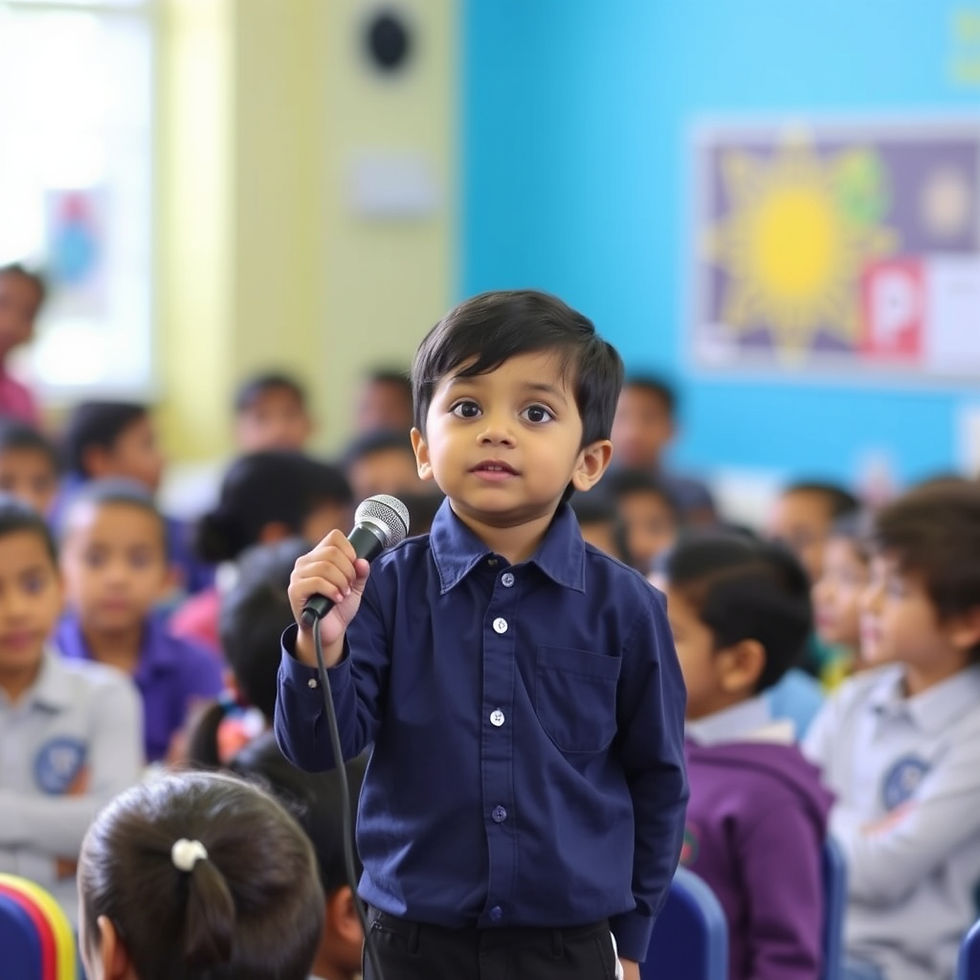
What Is Public Speaking for Children?
Public speaking for preschoolers simply means communicating ideas, thoughts, stories, or feelings in front of one or more people.
For a young child, public speaking might be:
Introducing themselves
Talking about a favorite toy
Reciting a rhyme
Telling a short story
Answering a question
Describing a picture
Participating in a role-play
Singing with classmates
Sharing an experience
Speaking during circle time
The purpose is not to make children perfect speakers. It is to help them become comfortable expressing themselves.
Why Should Every Child Learn Public Speaking?
Public speaking provides children with opportunities to develop several important skills at the same time.
1. Builds Self-Confidence
One of the biggest benefits of public speaking activities is increased confidence.
When a child successfully stands in front of classmates and says a few sentences, they experience a small but meaningful achievement.
Repeated positive experiences can teach children:
"I can do this."
This confidence can extend beyond speaking activities into classroom participation, friendships, creative activities, and everyday situations.
2. Improves Communication Skills
Good communication involves more than knowing words.
Children need to learn how to:
Express ideas
Form sentences
Listen to others
Answer questions
Speak clearly
Take turns
Explain their thoughts
Use appropriate expressions
Public speaking activities provide regular opportunities to practice these skills.
3. Develops Vocabulary
Storytelling, presentations, and Show and Tell expose children to new words.
For example, when a child describes a favorite animal, they may learn words such as:
Soft
Fast
Wild
Small
Friendly
Hungry
Habitat
Using vocabulary in meaningful conversations makes language learning more engaging.
4. Improves Listening Skills
Public speaking is closely connected to listening.
Children learn that communication involves both speaking and paying attention to others.
During group activities, children can practice:
Listening to classmates
Waiting for their turn
Following instructions
Remembering information
Responding appropriately
These skills are useful both inside and outside the classroom.
5. Helps Children Express Their Ideas
Every child has thoughts, questions, opinions, and stories to share.
Public speaking activities provide children with opportunities to communicate those ideas.
For example, a teacher might ask:
"What did you do this weekend?"
A child may begin with a short answer and gradually learn to provide more details.
This encourages organized thinking and self-expression.
6. Reduces Fear of Speaking in Front of Others
Some children naturally feel nervous when speaking before a group.
Introducing public speaking gradually can help children become more comfortable.
A child might progress from:
Speaking to parents → Speaking to a teacher → Speaking to a small group → Speaking to classmates → Giving a short presentation
The goal is not to eliminate nervousness completely but to help children learn that they can participate even when they feel a little nervous.
7. Develops Social Skills
Public speaking activities often involve interaction with other children.
Children learn to:
Take turns
Listen respectfully
Respond to questions
Encourage classmates
Work in groups
Share ideas
Respect different opinions
These experiences can support healthy social development.
8. Encourages Creativity
Public speaking does not always require children to repeat memorized sentences.
Creative speaking activities allow children to invent:
Characters
Stories
Adventures
Conversations
Songs
Funny situations
Alternative endings
For example, a teacher could show a picture of a mysterious forest and ask:
"What do you think is hiding behind the tree?"
There can be many creative answers.
9. Strengthens Memory and Organization
When children prepare a short story, rhyme, or presentation, they practice remembering information and putting ideas into a logical order.
They begin to understand simple structures such as:
Beginning → Middle → End
This can support memory, sequencing, and early thinking skills.
10. Builds Leadership Skills
Speaking opportunities can also introduce children to leadership.
A child might be asked to:
Lead a rhyme
Explain a game
Welcome classmates
Help demonstrate an activity
Tell a story
Lead a simple group task
These experiences help children understand that their voice can positively influence others.
11. Supports Emotional Expression
Children need vocabulary to communicate their feelings.
Public speaking and storytelling activities can encourage children to talk about emotions such as:
Happiness
Sadness
Excitement
Fear
Anger
Surprise
Worry
For example:
"How do you think the character feels? Why?"
Such questions encourage emotional awareness and communication.
12. Prepares Children for School and Beyond
Communication skills become increasingly important as children progress through school.
Children may eventually need to:
Answer questions in class
Participate in discussions
Give presentations
Read aloud
Work in groups
Explain projects
Speak with teachers
Communicate with new people
Introducing these skills early can make future communication experiences more familiar.
Best Public Speaking Activities for Preschoolers
Public speaking for young children should be fun, short, interactive, and age-appropriate.
Here are some effective activities.
1. Show and Tell
Ask children to bring or choose a familiar object and talk about it.
They can answer:
What is it?
What is its name?
Where did you get it?
Why do you like it?
How do you use it?
Because children already know the subject, Show and Tell can be a comfortable introduction to public speaking.
2. Storytelling
Give children a picture book and invite them to retell the story.
Older preschoolers can also create their own stories.
Storytelling develops:
Vocabulary
Memory
Creativity
Sentence formation
Expression
Confidence
3. Puppet Shows
Puppets can make speaking feel like play.
Children can use different puppets to create conversations.
For example:
Puppet 1: "Where are you going?"
Puppet 2: "I am going to the park."
This allows children to practice dialogue without feeling like they are giving a formal speech.
4. Picture Description
Show a colorful picture and ask children to describe it.
Questions can include:
What do you see?
Who is in the picture?
What are they doing?
Where are they?
What might happen next?
This activity encourages children to use descriptive language.
5. Role-Play
Children can pretend to be:
Doctors
Teachers
Shopkeepers
Pilots
Chefs
Police officers
Community helpers
Role-play encourages children to communicate naturally while using their imagination.
6. Rhyme and Song Presentation
Rhymes and songs are excellent for early speaking practice.
Children can perform individually, with a partner, or as a group.
They practice:
Pronunciation
Rhythm
Voice
Memory
Expression
7. Circle-Time Conversations
Circle time gives children opportunities to speak in a familiar classroom environment.
Teachers can ask:
"What is your favorite fruit?"
"What did you do yesterday?"
"Which animal do you like?"
Short conversations gradually develop speaking confidence.
8. Story Chain
One child starts a story, and each child adds a sentence.
For example:
Child 1: "There was a little rabbit."
Child 2: "The rabbit lived near a forest."
Child 3: "One day, it found a treasure."
This activity combines listening, memory, creativity, and speaking.
How Parents Can Practice Public Speaking at Home
Public speaking development does not need to stop at school.
Parents can create simple opportunities at home.
Create a Mini Stage
Choose a small area where your child can tell a story, sing, or recite a rhyme.
Ask Open-Ended Questions
Instead of questions requiring only "yes" or "no," ask:
"What was your favorite part of school today?"
Let Children Explain Their Activities
Ask your child to explain a drawing, block construction, or craft project.
Read Stories Together
After reading a story, ask your child to retell it.
Play Pretend Games
Use toys and household objects to create imaginary situations.
Celebrate Effort
Focus on participation rather than perfection.
Say:
"I loved how you tried to explain your idea."
rather than only praising a perfect performance.
What Parents Should Avoid
Public speaking should never become a source of unnecessary pressure.
Avoid:
Forcing children to perform
Laughing at mistakes
Comparing children
Expecting perfect pronunciation
Making children memorize long speeches
Criticizing nervousness
Interrupting constantly
Turning every activity into a competition
A supportive approach helps children associate speaking with positive experiences.
How Teachers Can Encourage Young Speakers
Teachers have an important role in developing communication confidence.
A supportive teacher can:
Provide preparation time
Begin with small groups
Encourage participation
Ask open-ended questions
Celebrate effort
Allow children to make mistakes
Use storytelling and role-play
Give children simple leadership opportunities
Create a safe classroom environment
Children are more likely to speak when they know their ideas will be heard respectfully.
Public Speaking and Stage Fear
Public speaking activities can also help children gradually manage stage fear.
However, children should not be forced into large performances before they are ready.
A gradual approach may look like:
Step 1: Speak to a teacherStep 2: Speak to a partnerStep 3: Speak in a small groupStep 4: Speak during circle timeStep 5: Give a short presentationStep 6: Participate in a larger performance
This approach allows confidence to develop naturally.
How Kaiser Valley Future Ready AI Preschool Builds Communication Confidence
At Kaiser Valley Future Ready AI Preschool, communication development can be integrated into everyday learning.
Children can participate in activities such as:
Storytelling
Show and Tell
Rhymes and songs
Puppet shows
Role-play
Circle-time conversations
Picture description
Group discussions
Creative presentations
Confidence-building games
Leadership activities
AI-supported educational experiences
The objective is to make children active participants in their learning.
The Role of AI in Communication Learning
Modern preschool education can use technology to complement traditional teaching methods.
Age-appropriate AI-supported learning experiences can provide children with interactive opportunities involving:
Stories
Vocabulary
Questions
Visual learning
Creative prompts
Educational games
Personalized learning activities
However, technology should complement human interaction rather than replace it.
Real conversations with teachers, parents, and classmates remain essential for developing communication and social skills.
Why Public Speaking Is a Future-Ready Skill
The ability to communicate ideas clearly can be useful throughout life.
As children grow, communication may become important for:
Classroom presentations
Interviews
Group projects
Leadership
Collaboration
Creative expression
Academic activities
Professional situations
Starting with simple speaking activities during preschool can make communication a natural part of a child's development.
Why Choose the Best Preschool in Delhi for Communication Development?
Parents searching for the Best Preschool in Delhi often look beyond traditional academics.
A strong preschool should provide opportunities for children to develop:
Communication
Confidence
Creativity
Social skills
Emotional awareness
Problem-solving
Independence
Leadership
School readiness
At Kaiser Valley Future Ready AI Preschool, these skills can be developed through play-based, interactive, and age-appropriate learning experiences.
Our goal is to help children become confident communicators and curious, capable, future-ready learners.
Frequently Asked Questions
Why should children learn public speaking?
Public speaking helps children develop confidence, communication, vocabulary, listening, creativity, social skills, emotional expression, and the ability to organize their thoughts.
What is public speaking for preschool children?
For preschoolers, public speaking can include simple activities such as Show and Tell, storytelling, rhymes, picture description, role-play, circle-time conversations, and short presentations.
At what age should children start learning public speaking?
Children can begin developing basic speaking confidence during the preschool years. Activities should be simple, playful, age-appropriate, and focused on communication rather than formal speeches.
How can I improve my child's speaking confidence?
Give your child regular opportunities to talk, listen patiently, encourage storytelling, play role-based games, ask open-ended questions, celebrate effort, and avoid comparing your child with others.
Can public speaking reduce stage fear?
Gradual and positive speaking experiences can help children become more comfortable speaking before others. Small-group activities, storytelling, puppets, and Show and Tell can be useful starting points.
Does public speaking improve communication skills?
Yes. Speaking activities provide opportunities for children to practice vocabulary, sentence formation, listening, expression, turn-taking, and organizing their ideas.
Why is public speaking important at the Best Preschool in Delhi?
A preschool that encourages age-appropriate public speaking can help children build confidence, communication skills, creativity, social development, and school readiness in a supportive environment.
Conclusion
Every child deserves opportunities to develop a confident voice. Public speaking during the preschool years does not have to involve long speeches or formal presentations. Simple activities such as storytelling, Show and Tell, puppet shows, rhymes, role-play, picture description, and group conversations can make speaking enjoyable.
The most important goal is not perfect performance. It is helping children feel comfortable sharing their thoughts and discovering that their ideas matter.
At Kaiser Valley Future Ready AI Preschool, communication and confidence can become part of everyday learning through play, creativity, interaction, and age-appropriate technology.
For parents searching for the Best Preschool in Delhi, choosing a preschool that supports communication, confidence, creativity, and social-emotional development can help children build skills that remain valuable throughout their educational journey.
Give your child a voice, give them opportunities to use it, and let confidence grow one conversation at a time.

Comments