

Storytelling Activities That Improve Communication | Best Preschool in Delhi.

Storytelling is much more than an entertaining activity for young children. It is a powerful way to develop language, communication, confidence, listening, creativity, memory, and social skills during the preschool years.
When children listen to stories, retell them, create characters, and share their own ideas, they naturally learn how to organize thoughts and communicate with others.
At Kaiser Valley Future Ready AI Preschool, storytelling is an important part of joyful, play-based learning. Through stories, picture books, role-play, puppets, rhymes, and interactive activities, children get regular opportunities to express themselves and develop confidence.
For parents searching for the Best Preschool in Delhi, a learning environment that combines communication development with creativity and play can provide an excellent foundation for future learning.
Storytelling Activities That Improve Communication | Best Preschool in Delhi.
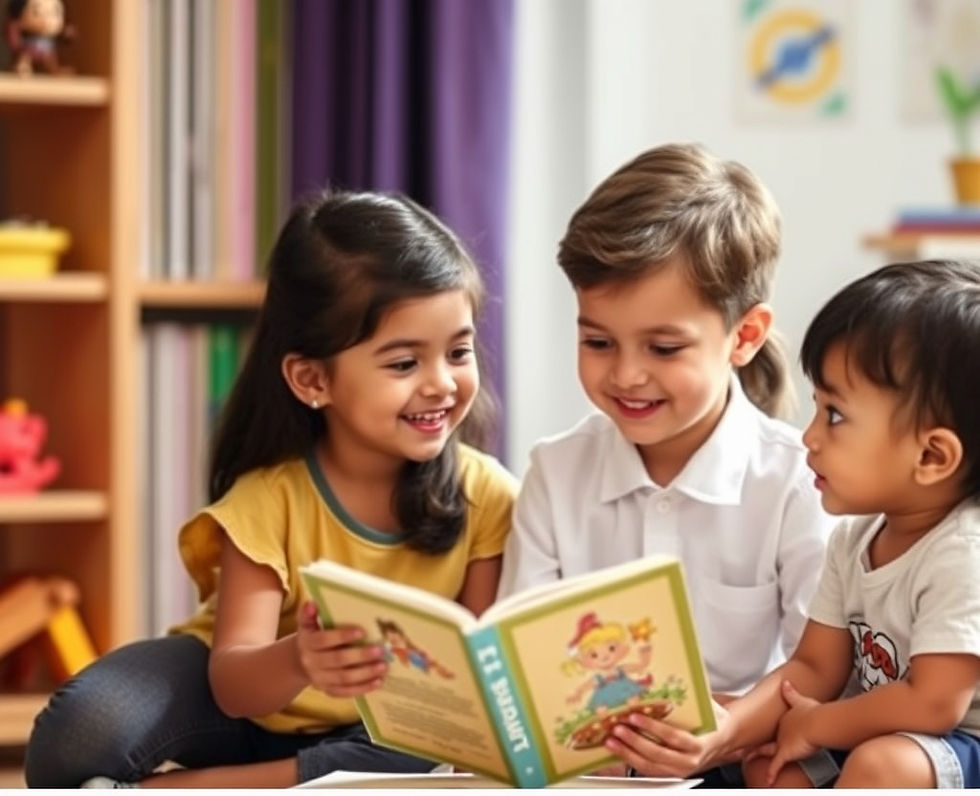
Why Storytelling Is Important for Preschool Communication
Young children learn language through meaningful interaction. Stories give them opportunities to hear new words, understand sentence patterns, listen carefully, and express their own thoughts.
Regular storytelling activities can help children:
Expand their vocabulary
Improve listening skills
Speak more clearly
Build confidence
Express emotions
Develop imagination
Improve memory
Organize their thoughts
Understand conversations
Develop social communication skills
Storytelling also makes language learning enjoyable rather than stressful.
10 Storytelling Activities That Improve Communication
1. Picture Storytelling
Show children a colorful picture and ask them to describe what they see.
Ask questions such as:
Who is in the picture?
What are they doing?
Where are they?
What might happen next?
How do you think they feel?
Children can begin with individual words and gradually develop complete sentences.
Communication skills developed: Vocabulary, observation, sentence formation, and expression.
2. Story Retelling
Read a short, age-appropriate story and ask children to retell it in their own words.
They can explain:
What happened first
What happened next
What happened at the end
Story retelling teaches children how to organize information in sequence.
Communication skills developed: Memory, sequencing, vocabulary, and speaking.
3. Puppet Storytelling
Puppets can make storytelling more interactive.
Children can use puppets to create conversations between different characters.
For example, one puppet could ask:
"Where are you going?"
The other puppet could respond:
"I am going to the park."
This activity encourages children to practice conversations in a playful environment.
Communication skills developed: Dialogue, expression, confidence, and social interaction.
4. Finish the Story
Start a story with a simple sentence and allow children to complete it.
For example:
"One morning, a little bird found a colorful box..."
Ask the child what happened next.
There are no wrong creative answers. The goal is to encourage children to express ideas freely.
Communication skills developed: Creativity, vocabulary, imagination, and spontaneous speaking.
5. Storytelling with Props
Use toys, blocks, dolls, animals, or household objects as storytelling props.
Children can create stories around the objects.
For example:
A toy car could become part of a story about a family going on an adventure.
Props make storytelling more concrete and engaging for young learners.
Communication skills developed: Vocabulary, imagination, descriptive language, and confidence.
6. Story Chain Game
Story Chain is a group activity where each child adds one sentence to a shared story.
The first child starts:
"There was a little rabbit in a big garden."
The next child continues:
"The rabbit found a beautiful flower."
Another child adds the next part.
This activity teaches children to listen carefully because their contribution needs to connect with what came before.
Communication skills developed: Listening, cooperation, memory, and verbal expression.
7. Storytelling Through Role-Play
Children can act out familiar stories or create their own characters.
They might become:
Animals
Doctors
Teachers
Superheroes
Community helpers
Storybook characters
Role-play allows children to combine movement, language, imagination, and emotional expression.
Communication skills developed: Conversation, confidence, body language, and social interaction.
8. Story Sequencing Cards
Give children several pictures showing different parts of a simple story.
Ask them to arrange the pictures in the correct order and explain what happened.
This helps children understand beginning, middle, and end.
Communication skills developed: Sequencing, logical thinking, memory, and sentence formation.
9. Storytelling with Emotions
Ask children to tell a story using different emotions.
They can speak like a character who is:
Happy
Sad
Excited
Surprised
Worried
Angry
This helps children understand how voice, facial expressions, and body language communicate feelings.
Communication skills developed: Emotional expression, voice modulation, empathy, and confidence.
10. Create Your Own Story
Give children a few simple prompts:
Character: A little elephantPlace: A magical forestObject: A red balloon
Ask the child to create a story using all three.
This encourages independent thinking and gives children freedom to express their imagination.
Communication skills developed: Creativity, vocabulary, confidence, and independent expression.
How Storytelling Improves Vocabulary
Children are introduced to new words naturally through stories.
For example, a story about a forest might introduce words such as:
Forest
Adventure
Explore
Tiny
Gigantic
Curious
Friendly
Instead of memorizing vocabulary from a list, children understand words through context.
This makes new vocabulary easier to remember and use in everyday conversations.
Storytelling Builds Listening Skills
Good communication requires both speaking and listening.
During storytelling, children learn to:
Pay attention
Remember important details
Follow instructions
Understand characters
Predict events
Respond to questions
These listening skills are important for classroom learning and social relationships.
Storytelling Builds Speaking Confidence
Some children may initially hesitate to speak in front of others.
Storytelling gives them a comfortable way to practice.
They can begin with:
One word → One sentence → Short story → Group storytelling → Presentation
With regular encouragement, children can gradually become more comfortable expressing themselves.
Storytelling Supports Emotional Development
Stories help children understand feelings and relationships.
When children discuss characters, they can explore questions such as:
Why is the character sad?
What made the character happy?
How could we help?
What would you do?
Was the character kind?
These conversations help children develop empathy and emotional vocabulary.
Storytelling and Creativity
A good storytelling activity does not always have one correct answer.
Children can imagine:
Different endings
New characters
Magical places
Creative solutions
New adventures
This encourages children to think independently and communicate original ideas.
How Kaiser Valley Uses Storytelling for Communication Development
At Kaiser Valley Future Ready AI Preschool, storytelling can be integrated into everyday learning through:
Picture books
Interactive storytelling
Puppet shows
Story sequencing
Role-play
Rhymes and songs
Picture description
Group storytelling
Creative story creation
Question-and-answer activities
AI-supported educational experiences
The objective is to make children active participants rather than passive listeners.
The Role of Teachers in Storytelling
A teacher can make storytelling more effective by asking open-ended questions and encouraging children to participate.
Instead of simply asking:
"Did you like the story?"
a teacher can ask:
"Which character did you like most, and why?"
This encourages children to explain their thoughts.
Teachers can also:
Use expressive voices
Change facial expressions
Use gestures
Pause for questions
Encourage predictions
Invite children to retell stories
Celebrate creative answers
These techniques make storytelling interactive and meaningful.
How Parents Can Use Storytelling at Home
Parents do not need expensive resources to encourage storytelling.
Try these simple activities:
Read Together Every Day
Choose short, age-appropriate stories and discuss them afterward.
Ask Open-Ended Questions
Ask children what they think might happen next.
Let Children Retell Stories
Encourage them to explain the story using their own words.
Create Family Stories
Take turns adding sentences to a shared story.
Use Everyday Objects
A spoon, toy, pillow, or box can become part of an imaginary story.
Encourage Imagination
Allow children to create unusual or funny stories without immediately correcting them.
Storytelling and School Readiness
Communication skills developed through storytelling can support children when they enter formal schooling.
Children who have opportunities to communicate may become more comfortable with:
Answering questions
Participating in classroom discussions
Following instructions
Talking with teachers
Working with classmates
Giving simple presentations
Expressing their needs
Storytelling therefore supports both language development and school readiness.
The Role of AI-Supported Learning
Modern preschool education can combine traditional storytelling with carefully designed technology.
At Kaiser Valley Future Ready AI Preschool, AI-supported educational experiences can complement teacher-led storytelling by making certain learning activities more interactive and engaging.
Age-appropriate technology may support:
Interactive stories
Vocabulary activities
Visual learning
Question-and-answer exercises
Personalized learning experiences
Creative storytelling prompts
Technology should complement real conversations, books, play, and teacher interaction—not replace them.
Why Choose Kaiser Valley Future Ready AI Preschool?
Parents searching for the Best Preschool in Delhi often look for a school that supports more than early academics.
Kaiser Valley Future Ready AI Preschool focuses on holistic development through:
Play-based learning
Storytelling
Communication activities
Creative expression
Social-emotional development
Music and rhymes
Role-play
Interactive learning
AI-supported educational experiences
Confidence building
School readiness
Our goal is to help children become confident communicators, creative thinkers, curious learners, and future-ready individuals.
Frequently Asked Questions
How does storytelling improve communication in preschool children?
Storytelling helps children develop vocabulary, listening, sentence formation, memory, confidence, emotional expression, and the ability to organize and communicate ideas.
What is the best storytelling activity for preschoolers?
There is no single best activity. Picture storytelling, story retelling, puppet shows, story sequencing, role-play, story chains, and creating original stories can all support communication development.
How often should children participate in storytelling?
Short, regular storytelling sessions are more useful than occasional long sessions. Parents and teachers can incorporate storytelling into everyday reading, play, and classroom activities.
Can storytelling help shy children communicate?
Yes. Storytelling can provide a comfortable and playful way for shy children to practice speaking. Puppets, small groups, and one-to-one storytelling can help children participate gradually.
Does storytelling improve vocabulary?
Yes. Stories expose children to new words in meaningful contexts and give them opportunities to hear, understand, and use those words during conversations.
Why is storytelling important at the Best Preschool in Delhi?
A strong preschool uses storytelling as part of holistic learning because it supports communication, creativity, listening, confidence, emotional development, and school readiness.
Conclusion
Storytelling is one of the simplest and most powerful ways to improve communication during the preschool years. When children listen to stories, retell them, create characters, use puppets, participate in role-play, and invent their own adventures, they develop language and communication skills while having fun.
At Kaiser Valley Future Ready AI Preschool, storytelling becomes an opportunity for children to listen, imagine, speak, participate, and connect with others. Combined with play-based education, creative activities, caring teachers, and AI-supported learning experiences, it helps create a strong foundation for lifelong communication and learning.
For parents searching for the Best Preschool in Delhi, Kaiser Valley Future Ready AI Preschool provides a nurturing environment where children can develop their voices, confidence, creativity, and curiosity.
Because every great communicator starts with a story.


Comments